IRiS Lakehouse Automation Software

Build the Silver layer your analytics and AI can trust

Stop hand-coding the same patterns table after table. IRiS proposes the model, your engineers confirm it, and IRiS writes the code for Microsoft Fabric, Snowflake and Databricks.

Hero BG

At a Glance

IRiS is Lakehouse Automation Software for data engineers and platform architects

It guides Silver layer data modelling and writes native code for Microsoft Fabric, Snowflake and Databricks, the same code every time. Your engineers confirm every business key, relationship and PII classification, and IRiS keeps a record of each decision for governance and AI. One source table takes under 15 minutes.

iconWS 6

IRiS proposes. Your engineers decide

IRiS never auto-approves a model.

iconIBM 3

Three outputs, one run

Native Silver layer code, a record of every modelling decision, and business context for your AI stack.

iconiris-software

Fits how you already ship

Code goes to your Git repository and through your existing release process.

iconAchieve more

Start small

No minimum seats, and one seat covers all three platforms.

The Problem

Why do Lakehouse projects stall at the Silver layer?

The Silver layer is where data from multiple source systems is integrated, modelled and governed. Bronze holds raw data as it lands. Gold is shaped for a specific report or use case. Silver is where the real engineering happens.

The Medallion Architecture leaves the detail to you: business keys, history, PII, data quality and lineage. Hand-build that detail and three things go wrong:

  • Delivery slows. Every table is modelled and coded by hand, and every engineer does it slightly differently.

  • Governance breaks. Inconsistent history, gaps in audit trails and broken lineage all start here.

  • AI gets it confidently wrong. Three source systems produce three definitions of "customer", and an AI agent reasons over all of them.

iris-lakehouse-automation 5

One run, three outputs

What does IRiS do?

IRiS connects to a source system and produces three outputs in one run:


Output What is it Who uses it
Native Silver layer code Platform-native code, the same every time. On Microsoft Fabric: SparkSQL in Fabric notebooks against Lakehouse Delta tables. Data engineers
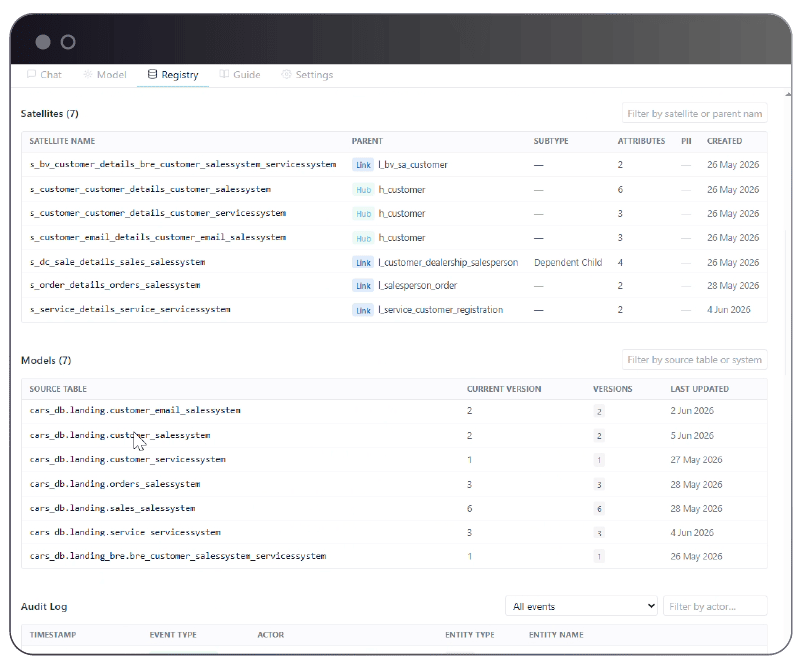
Metadata registry A JSON record of every modelling decision, business definition, PII classification, owner and relationship: your governance record Platform architects, governance teams
Ontology export Entities, relationships and properties, shaped for your platform's semantic layer Analytics and AI teams


Four phases

How does IRiS work?

Every phase works from your real source data and your business definitions. There are no blank pages and no hand-wired templates.

1.
Profile and understand

IRiS analyses your source schema, sample data and keys, proposes a type for every column, and flags PII for review.

2.
Confirm business identifiers

IRiS proposes the business keys: what makes a customer a customer, and an order an order. Your team confirms them. It's the most important modelling decision, so it's made once and made deliberately.

3.
Approve the model

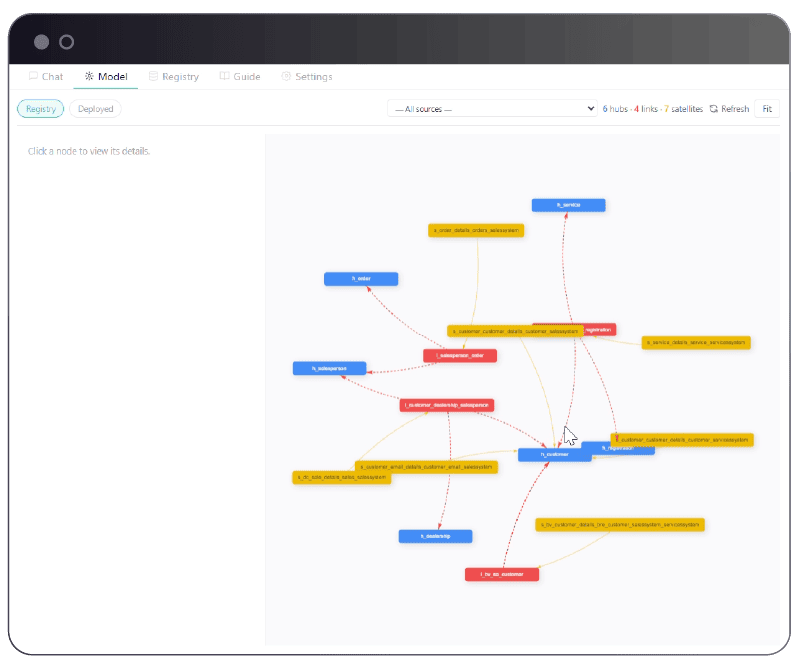
IRiS proposes entities, relationships and properties. Your team refines and approves, and IRiS records the model.

4.
Generate and hand off

IRiS generates the code, registry and ontology export, ready for your CI/CD pipeline.

How long does it take? A single source table can be profiled, modelled and have production-ready code generated in under 15 minutes. Most teams deliver their first business use case within a single sprint.

See it

What does IRiS output actually look like?

iris-step-1
You confirm the business keys

IRiS proposes the key. Nothing moves until an engineer approves it.

iris-step-2
IRiS writes the Silver layer code

Readable, platform-native SparkSQL, committed to your Git repository.

iris-step-3
IRiS records every decision

The same run produces your governance record.
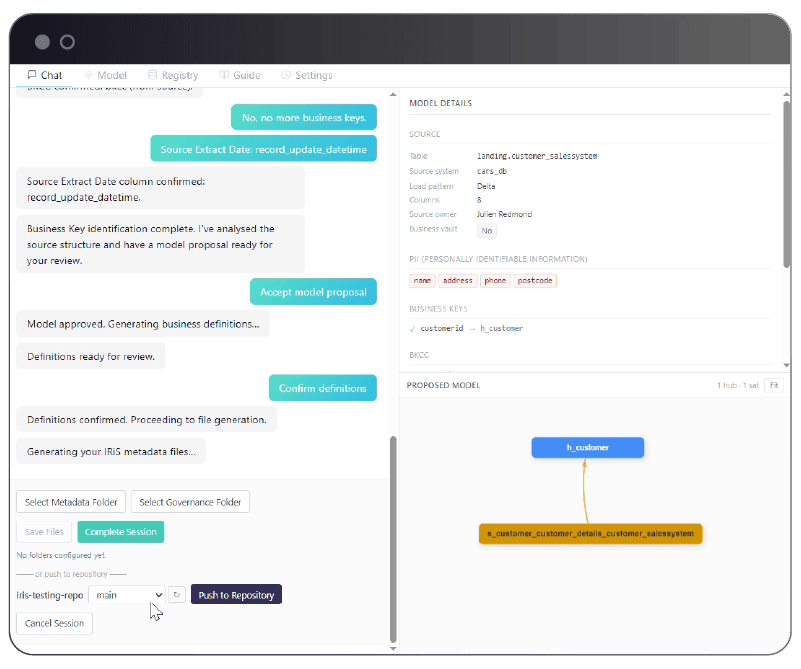
iris-app-screen-chat lrg
iris-app-screen-model lrg
iris-app-screen-registry lrg

IRiS Demo

See IRiS in action

Watch a 10-minute guided walkthrough of IRiS and see how it streamlines Silver layer delivery in your Lakehouse with focused, standards-aligned automation.


Who uses IRiS

Who uses IRiS?

Data Vault can be quite intimidating. IRiS made it fast, scalable, and relatively easy to configure. It would have been a lot more daunting without it."

Steven Mellare

Head of Data and Architecture | Resimac

You Decide

Who makes the decisions: IRiS or your team?

Your team does. IRiS proposes. Your engineers decide.

IRiS never auto-approves a model. Business keys, definitions and model sign-off always need confirmation from someone who knows the domain. IRiS takes away the repetitive work: template wiring, boilerplate SQL and metadata entry. Your engineers keep the judgement calls: which business keys are stable, which relationships are real, which attributes are sensitive.


Built in What it means for you  
Modelling guardrails Business keys stay stable, descriptive attributes sit on entities, and relationships are pairwise by default. Models don't drift.  
Model memory Every decision is kept in the registry, so the next session picks up where the last one ended. Nothing is re-guessed.  
Deterministic code The same registry produces the same code, byte for byte, so you can reproduce, audit and deploy it safely.  


Your Options

How is IRiS different from other ways to build the Silver layer?

Teams usually weigh IRiS against four other approaches. Each has strengths in the right context.


If you're considering… It's strong at… What IRiS adds
Your platform's native tooling Built in, integrated, familiar Guided modelling, consistent code and governance metadata, instead of leaving them to each engineer
Code-first transformation tools (e.g. dbt) Code-first delivery, a strong community, Gold layer transformation Guided design of the Silver layer itself. Works with dbt through Turbo Vault 
Other Data Vault automation software Mature Data Vault code generation Guided modelling for engineers without deep Data Vault expertise; business context for AI; no minimum seats
General-purpose AI coding assistants
Fast first drafts of SQL A general AI assistant has no memory of your model, no confirmed business keys and no guarantee of the same output twice. IRiS has all three.
 In-house frameworks Tailored to your team A maintained product with a roadmap, not a framework you have to keep alive

Built for AI

What does IRiS give your AI stack?

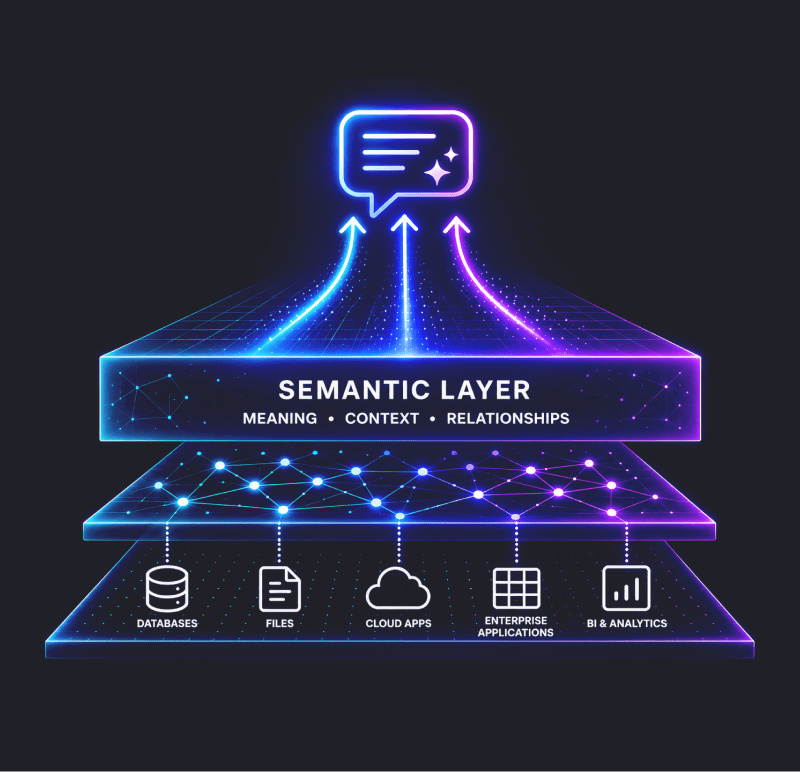
AI agents need structured business context to reason correctly: stable entity identity, complete history, explicit relationships, versioned definitions and lineage. IRiS captures these as your team models the Silver layer.

The IRiS registry works as an ontology: entities, typed relationships and defined properties. It comes from the modelling your team was already doing, with no separate authoring project.

IRiS doesn't replace your semantic layer or governance tools. It gives them a Silver layer they can trust.
IRiS_lp-img_the-model-is-the-message2-min

Your Platform

Which platforms does IRiS support?

One IRiS seat covers all three platforms, generated from a single registry.


  Microsoft Fabric (lead platform) Snowflake Databricks
Code IRiS generates SparkSQL in Fabric notebooks, Lakehouse Delta tables Native Snowflake tables Native Delta tables
Governance Lineage to Microsoft Purview Horizon Catalog tags Unity Catalog classifications
Semantic layer Ontology export for Fabric IQ (preview) Semantic View DDL Unity Catalog objects
Cloud Azure Azure, AWS Azure, AWS

Your Process


How does IRiS fit our engineering process?

IRiS works inside the process your already have:

Your Git, your release model. Generated code is committed to your Git repository, such as Azure DevOps, and promoted through your existing branch and release model.

Load patterns detected. IRiS detects each source's load pattern (CDC, delta, snapshot or full load) and generates accordingly.

Light on capacity. IRiS modelling runs are metadata-only. They don't move or transform data, so they aren't a meaningful consumer of Fabric capacity.

What happens to our code if we stop using IRiS?

It stays yours. IRiS generates platform-native code with no runtime dependency, committed to your own Git repository. If you stop subscribing, your Silver layer keeps running. ⚑ (confirm, including access to the registry after the subscription ends)

Your Data Security


Is IRiS safe to use with your data?

IRiS modelling runs work on metadata and don't move or transform your data. PII is detected during profiling, confirmed by your team and recorded, and every decision has an audit trail.

Your platform, your procurement

Where does IRiS run, and how do we buy it?

IRiS runs on Microsoft Fabric first, with native support for Snowflake and Databricks. One IRiS seat covers all three, generated from a single model.

$998 USD
per seat /  per month

  • Billed monthly

  • No minimum seats

  • Available on Microsoft Marketplace, and MACC-eligible, so IRiS seats can count against committed Azure spend

Frequently asked questions

Is IRiS a code generator or an AI assistant?
Both, in one product. The AI assists with source profiling, business key identification and relationship discovery. The code is then generated deterministically from the model your team confirms.
Do we need Data Vault expertise to use IRiS?
No specialist certification is needed. IRiS builds in Data Vault 2.1 patterns and presents the model as entities, relationships and properties. Engineers who know the business domain get the most from it.
Does IRiS work with dbt?
Yes. IRiS designs and generates the Silver layer, and teams standardised on dbt can connect IRiS through Turbo Vault. dbt remains well suited to Gold layer transformation above the Silver layer.
How many seats do we need to start?

Most teams start with one or two seats for the engineers building their first use case, and add seats as delivery grows. There's no minimum.

What does the free trial include?
The free trial includes the full IRiS product on your chosen platform and a pilot workshop so you can model and generate code for a real source during the trial.
Can we buy IRiS through our Microsoft Azure commitment?
Yes. IRiS is available on Microsoft Marketplace and is MACC-eligible, so IRiS seats can count against your committed Azure spend.
Does IRiS produce an ontology for Microsoft Fabric IQ?
IRiS exports entities, relationships and properties from the same run that generates your code, shaped for Fabric IQ ⚑, which is currently in preview.
How is IRiS related to Ignition Data?
IRiS is standalone software with its own roadmap, built by the team behind Ignition Data. Ignition Data is one of several IRiS partners across Asia Pacific, Europe and North America.

Where to next

Build a Silver layer you can trust, starting with one use case

Try IRiS on your own source data. Most teams deliver their first business use case within a single sprint.